
What you need to know
- State the functions of epidermal, palisade and spongy mesophyll tissues.
- Compare xylem and phloem.
- Explain the roles of meristem tissue, guard cells and stomata.
- Identify vascular bundles in roots, stems and leaves.
- Link the position of each tissue to its function.
Protective tissues
Epidermal tissue covers the outer surfaces of a plant. Closely packed cells form a protective barrier. On exposed aerial surfaces, epidermal cells may release a transparent, waxy cuticle that reduces evaporation while allowing light to enter.
Root epidermis usually lacks a thick waxy cuticle because roots must absorb water. Some root epidermal cells grow long extensions to become root hair cells.
Misconception AlertThe waxy cuticle is a layer of living cells.Select to reveal the correctionSelect to hide the correction
The cuticle is a non-cellular waxy layer produced by epidermal cells.
Photosynthetic and gas-exchange tissues
| Tissue | Structure | Function |
|---|---|---|
| Palisade mesophyll | Elongated, closely packed cells containing many chloroplasts; usually near the upper leaf surface. | Absorbs light and carries out most photosynthesis. |
| Spongy mesophyll | Irregular cells with large interconnected air spaces and moist surfaces. | Allows carbon dioxide and oxygen to diffuse through the leaf; also photosynthesises. |
The air spaces connect internal cells to stomata. A short diffusion path from the air spaces to mesophyll cell surfaces supports rapid gas exchange.
Vascular tissues
Xylem
- Dead, hollow vessels with lignified walls.
- Transports water and mineral ions mainly upwards.
- Also adds mechanical support.
Phloem
- Living sieve tube elements supported by companion cells.
- Transports dissolved sugars and other assimilates.
- Movement can be upwards or downwards in different tubes.
Xylem and phloem occur together in vascular bundles, allowing each organ to receive water and export or import assimilates.
Meristem tissue, guard cells and stomata
Meristem tissue contains unspecialised, actively dividing cells. It occurs at root and shoot tips and in lateral growth regions. New cells differentiate into the tissues needed by the growing organ.
A stoma is a pore, usually in the epidermis of a leaf. Two guard cells alter their shape as their turgor changes, controlling the size of the opening. This regulates carbon-dioxide entry and water-vapour loss.
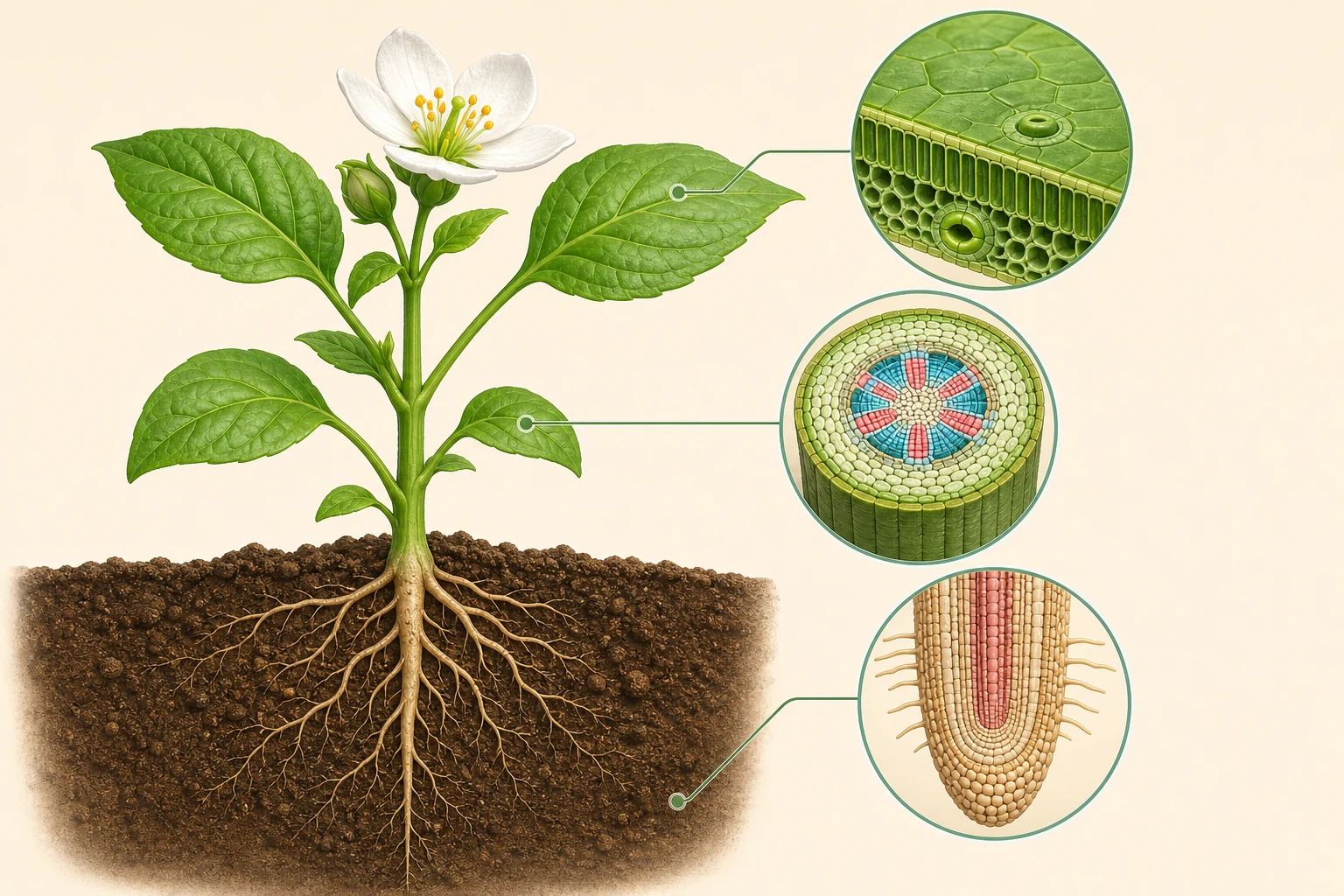
Where vascular bundles occur
| Organ | Typical arrangement and value |
|---|---|
| Root | Vascular tissue lies centrally, helping resist pulling forces and move absorbed materials into the stem. |
| Stem | Bundles run along the stem; their pattern supports the organ and connects roots with leaves. |
| Leaf | Bundles form veins that branch across the blade, shortening transport distances and supporting the lamina. |
When shown an unfamiliar micrograph, identify a tissue from several features, not colour alone. Stains and diagrams may use different colours.
Quick retrieval check
1. Why is the cuticle transparent?
2. Why are palisade cells near the upper surface?
3. Give one structural difference between xylem and phloem.
4. What controls the size of a stoma?
Exam connection
A leaf vein contains both xylem and phloem. Explain why both tissues are required by a photosynthesising leaf.
Show the mark points
- Xylem supplies water needed for photosynthesis.
- Xylem also supplies dissolved mineral ions.
- Photosynthesis produces sugars in mesophyll cells.
- Phloem transports dissolved sugars away to growing or storage tissues.