
What you need to know
- Order cell, tissue, organ, organ system and organism.
- Identify roots, stems, leaves and flowers as plant organs.
- Relate each organ's structures to its functions.
- Explain how transport connects roots and shoots.
- Describe meristems as regions of cell division and differentiation.
Levels of organisation
Plant organisation is not a set of independent parts. Water absorbed by root hair cells enters xylem tissue, travels through root and stem organs, and reaches the leaves where it supports photosynthesis and replaces water lost by transpiration.
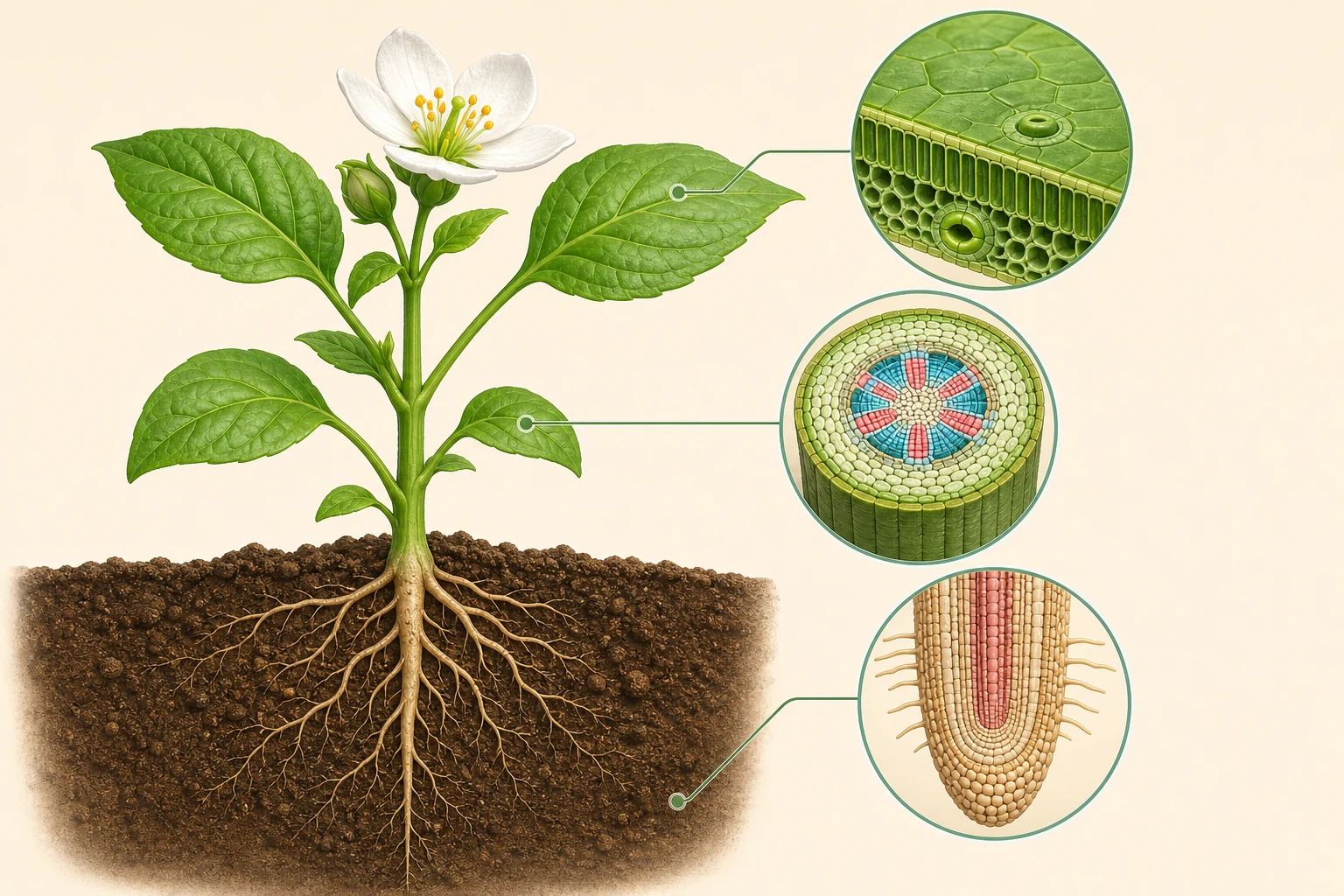
The main plant organs
| Organ | Main functions | Important adaptations |
|---|---|---|
| Root | Anchorage; absorption of water and mineral ions; storage in some plants. | Branching system and root hairs provide a large contact area with soil. |
| Stem | Supports leaves and flowers; transports water, minerals and assimilates. | Vascular bundles contain xylem and phloem; lignified tissues add strength. |
| Leaf | Photosynthesis, gas exchange and transpiration. | Broad, thin surface with chloroplast-rich cells, air spaces and stomata. |
| Flower | Sexual reproduction. | Structures produce gametes and enable pollination, fertilisation and seed formation. |
Misconception AlertA leaf is a single tissue.Select to reveal the correctionSelect to hide the correction
A leaf is an organ containing epidermal, mesophyll and vascular tissues working together.
Root and shoot systems cooperate
The root system anchors the plant and collects water and mineral ions. The shoot system includes stems, leaves, buds and flowers. It captures light and carbon dioxide, supports reproduction and distributes materials.
- Xylem connects roots to shoots and carries water and mineral ions mainly upwards.
- Phloem carries dissolved sugars and other assimilates between sources and sinks.
- Leaves manufacture sugars; roots, fruits and growing tissues may receive or store them.
- Roots require sugars for respiration, while leaves depend on roots for water and mineral ions.
Meristems and plant growth
A meristem is a region containing unspecialised cells that divide by mitosis. Apical meristems at root and shoot tips increase length. Lateral meristems in some plants increase width.
New cells produced by mitosis can enlarge and differentiate into specialised cells. Because meristems remain active, many plants can continue growing and can form new organs throughout life.
Root-tip meristem
Produces cells that extend the root through soil and later form root tissues.
Shoot-tip meristem
Produces cells for stem extension, new leaves, buds and sometimes flowers.
Separate the stages: mitosis increases cell number, cell elongation increases size, and differentiation produces specialised cell types.
Quick retrieval check
1. What is an organ?
2. Give two functions of a stem.
3. Why do roots need sugars from leaves?
4. What happens to cells made in a meristem?
Exam connection
Explain why damage that completely removes a ring of phloem from a young tree can eventually reduce root growth.
Show the mark points
- Leaves produce sugars by photosynthesis.
- Phloem normally transports dissolved sugars to roots.
- Removing a complete ring interrupts this transport pathway.
- Root cells receive less sugar for respiration and production of new material.
- Cell division and growth are reduced.