
What you need to know
- Relate dead, hollow xylem vessels to efficient water flow.
- Explain the roles of lignin and pits.
- Trace water from soil to the atmosphere.
- Describe cohesion and transpiration pull at GCSE level.
- Explain how xylem and turgor support plants.
Xylem vessel structure
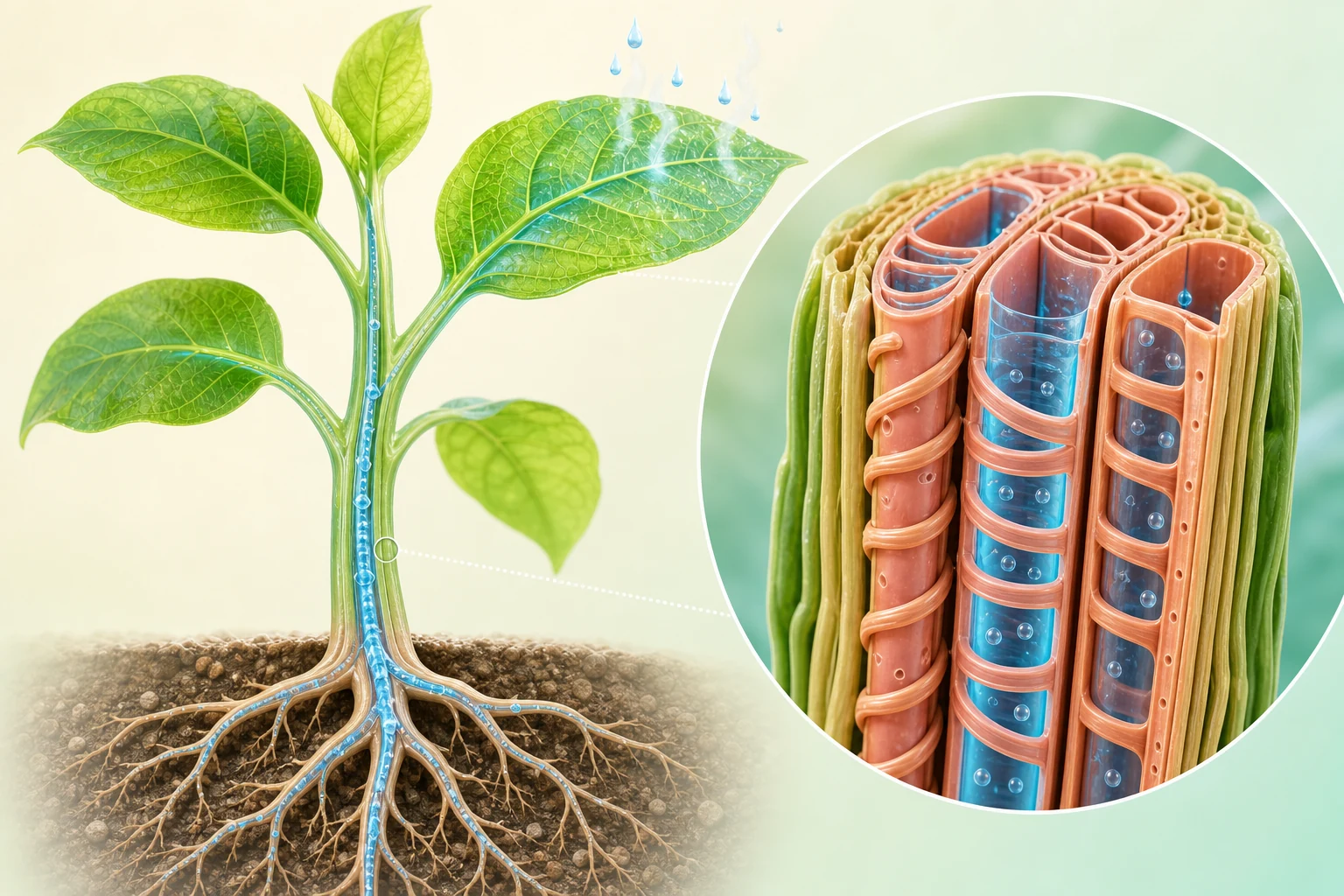
- Vessel elements are dead at maturity, so they contain no cytoplasm blocking the lumen.
- End walls are absent or broken down, producing long continuous tubes.
- Walls contain waterproof lignin, often in rings or spirals.
- Lignin strengthens vessels and prevents them collapsing under tension.
- Unlignified pits allow sideways movement between vessels and surrounding tissues.
Misconception AlertA xylem vessel is one giant cell.Select to reveal the correctionSelect to hide the correction
Xylem is a tissue. Each vessel is formed from many vessel elements joined end to end.
From soil to atmosphere
This continuous route is the transpiration stream. Water also supplies photosynthesis, maintains turgor, carries dissolved ions and cools leaves by evaporation.
Cohesion and transpiration pull
Water evaporating from moist mesophyll cell walls lowers water potential in the leaf. Water moves from leaf xylem into mesophyll tissues. This creates tension that pulls the water column upwards.
Water molecules attract one another through cohesion, helping the column remain continuous. Adhesion to vessel walls also contributes. No pump in the roots or stem drives the whole pathway.
The tension produced when evaporation from leaves draws a continuous column of water upwards through xylem.
How plants are supported
Lignified xylem provides rigid structural support. Water also supports non-woody tissues: water entering vacuoles makes cells turgid, and the cell contents press against strong cell walls.
When water loss exceeds uptake, cells lose turgor and tissues become limp. Wilting reduces leaf exposure and may lower water loss, but it also reduces photosynthesis and growth.
Lignin support
Rigid, long-lasting reinforcement in xylem and woody tissues.
Turgor support
Reversible support produced by water-filled living cells pressing against their walls.
Tracing the transport pathway
A cut leafy shoot placed in coloured water can show which tissues transport water. After time, thin cross-sections of the stem reveal stain mainly in xylem.
Cut the stem under water to reduce entry of air, keep conditions constant and use an unstained control for comparison. Colour reaching leaves supports the existence of a continuous pathway, but the dye may not move exactly like every dissolved mineral ion.
Use appropriate cutting tools with supervision and cut away from fingers. Compare similar shoots with equal leaf area and exposure time.
Quick retrieval check
1. Why are mature xylem vessels hollow?
2. Give two functions of lignin.
3. What creates transpiration pull?
4. Why does a herbaceous plant wilt?
Exam connection
Explain how the structure of a xylem vessel allows it to transport water under tension.
Show the mark points
- Vessel elements are dead and hollow, providing a low-resistance lumen.
- Missing end walls form a continuous tube.
- Lignified walls are strong.
- They resist collapse as transpiration pull creates tension.
- Pits allow sideways movement of water.