
What you need to know
- Describe sieve tube elements, sieve plates and companion cells.
- Define translocation and assimilates.
- Identify sources and sinks in different situations.
- Explain why movement can occur upwards and downwards.
- State how transported sugars are used.
Phloem structure
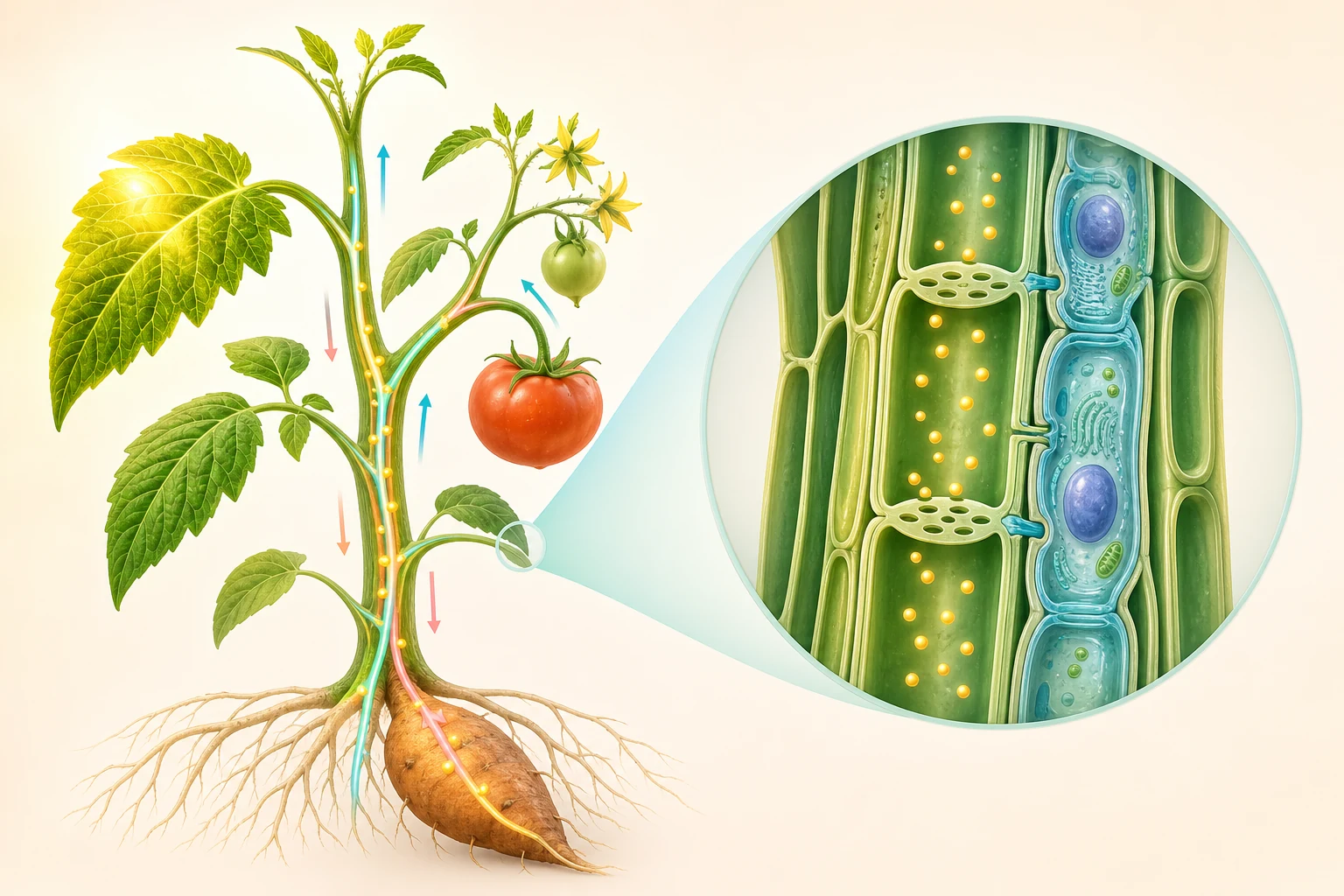
Phloem is living tissue. Sieve tube elements join end to end, and their perforated end walls form sieve plates. Mature sieve elements contain very little cytoplasm and lack a nucleus, leaving space for phloem sap.
Each sieve tube element is closely associated with one or more companion cells. Companion cells contain a nucleus, dense cytoplasm and many mitochondria. They carry out metabolic processes that maintain sieve tubes and help load or unload assimilates.
Misconception AlertPhloem is hollow, dead tissue like xylem.Select to reveal the correctionSelect to hide the correction
Phloem sieve-tube elements and companion cells are living. Mature xylem vessels are dead and hollow.
Translocation and assimilates
The transport of dissolved assimilates through phloem from sources to sinks.
An assimilate is a substance made or incorporated by the plant. Sucrose is the principal transported sugar in many plants. Amino acids and some other organic solutes can also travel in phloem.
At a sink, sugars may be:
- used in respiration;
- built into cellulose for cell walls;
- combined with nitrate-derived amino acids to make proteins;
- converted to starch or lipids for storage;
- used to build flowers, fruits, seeds, roots or new leaves.
Sources and sinks
Source
A region that releases more assimilate than it uses. Mature photosynthesising leaves are common sources.
Sink
A region that removes assimilate for use or storage. Growing tips, roots, fruits and seeds are common sinks.
A structure's role can change. A storage root is a sink when accumulating sugar but becomes a source when stored carbohydrate is mobilised for new spring growth. A young leaf is initially a sink and becomes a source when its photosynthesis exceeds its own needs.
Direction of transport
Unlike the mainly upward xylem stream, phloem transport is not described by one direction for the whole plant. In one sieve tube, sap moves from its current source to its current sink. At the same time, another tube may carry assimilates in the opposite direction.
Energy is needed for processes such as loading sucrose into phloem and unloading it at some sinks. Pressure differences then contribute to bulk movement along sieve tubes.
Say “movement can occur in both directions in different phloem tubes”, not that one portion of sap moves both ways at once.
Evidence for translocation
Radioactively labelled carbon dioxide can be supplied to one leaf. The carbon becomes incorporated into sugars during photosynthesis. Later detection of the label in phloem and sink tissues shows where assimilates moved.
Removing a ring of bark that includes phloem causes sugars to accumulate above the cut while tissues below receive less. Interpret this carefully because severe damage may also affect other tissues and plant health.
A tracer must be detectable, incorporated into the substance being studied and used with appropriate safety controls. Evidence of location over time allows a transport pathway to be inferred.
Quick retrieval check
1. What passes through sieve plates?
2. Why do companion cells contain many mitochondria?
3. Give one source and two sinks.
4. Why can a storage root change from sink to source?
Exam connection
In early spring, sugars move from a storage organ to developing buds. Later, sugars move from mature leaves to the storage organ. Explain the change.
Show the mark points
- In early spring the storage organ is a source because it releases stored carbohydrate.
- Developing buds are sinks because they respire and build new cells.
- Later, mature leaves photosynthesise and become sources.
- The storage organ becomes a sink as sugars are transported there and stored.