
What you need to know
- Explain how a leaf's broad, thin shape supports photosynthesis.
- Relate each tissue layer to light absorption and gas exchange.
- Describe diffusion of carbon dioxide and oxygen through stomata.
- Explain how guard cells regulate stomatal opening.
- Prepare or interpret leaf sections and calculate stomatal density.
Adaptations of the whole leaf
- A broad lamina provides a large surface area for light absorption.
- The leaf is thin, so gases have a short diffusion distance.
- Leaves are arranged to reduce excessive overlap and shading.
- A transparent epidermis and cuticle allow light to reach palisade cells.
- Branching veins bring water close to cells and carry sugars away.
The large surface area also increases potential evaporation. Leaf structure therefore reflects a compromise between carbon-dioxide uptake and water conservation.
Inside a leaf
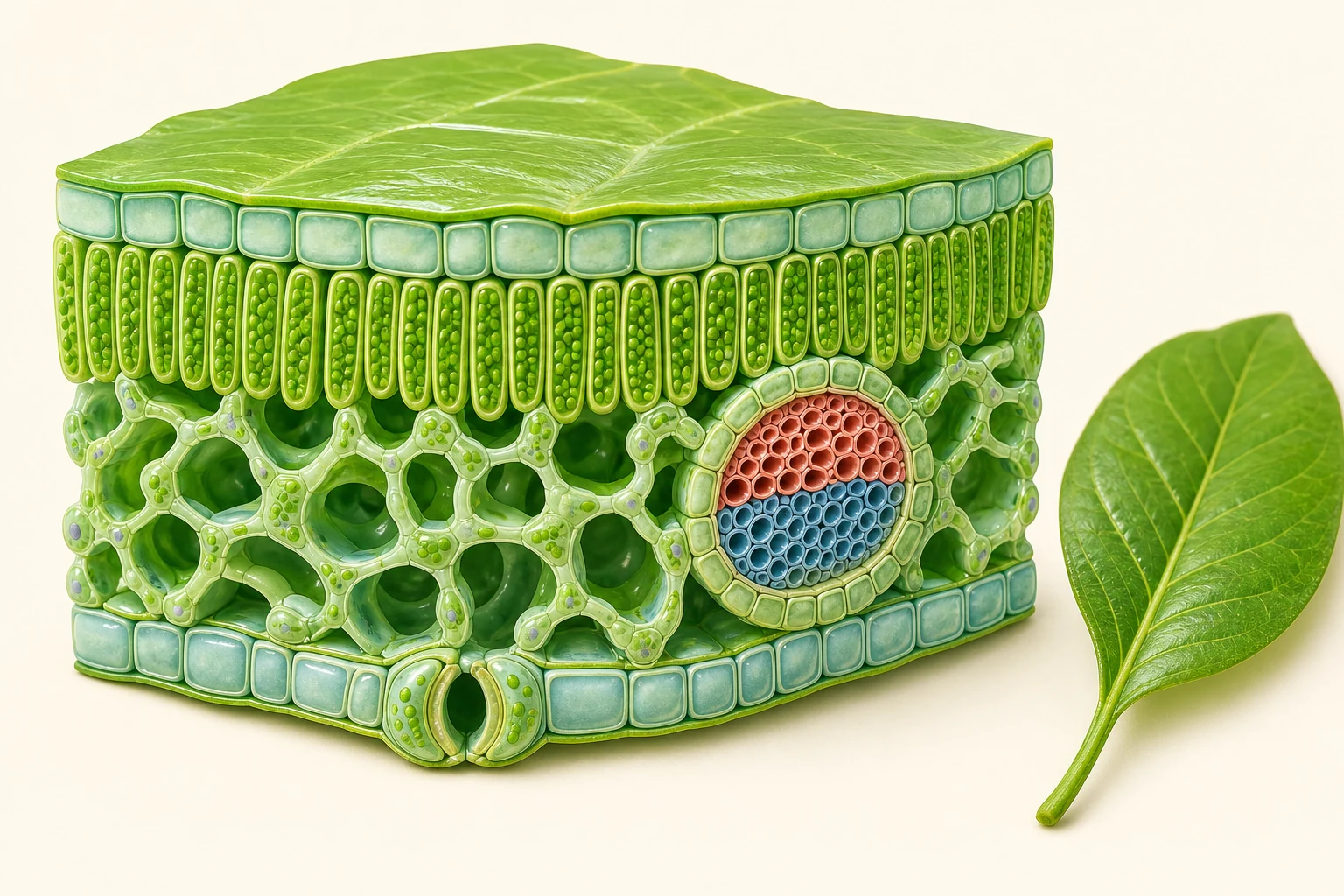
| Structure | Contribution |
|---|---|
| Waxy cuticle | Reduces evaporation from exposed surfaces. |
| Upper epidermis | Protective and transparent, allowing light through. |
| Palisade mesophyll | Packed with chloroplasts and positioned near the upper surface. |
| Spongy mesophyll | Large air spaces and moist cell surfaces allow gases to diffuse. |
| Vascular bundle | Xylem supplies water and minerals; phloem transports assimilates. |
| Lower epidermis | Often contains many stomata controlled by guard cells. |
Stomata and guard cells
Carbon dioxide diffuses from the atmosphere through open stomata, through the interconnected air spaces and into mesophyll cells. Oxygen produced in photosynthesis can diffuse in the opposite direction. Oxygen also enters for respiration when internal concentration is lower.
When guard cells become turgid, their unevenly thickened walls make them curve apart and open the pore. When they lose water and become less turgid, the pore closes. Light, water availability and internal signals influence this response.
Misconception AlertGuard cells pump carbon dioxide and oxygen through stomata.Select to reveal the correctionSelect to hide the correction
Guard cells control the size of the stomatal opening. Gases move through the opening by diffusion.
The gas-exchange trade-off
Open stomata allow carbon dioxide to enter for photosynthesis, but water vapour also diffuses out. Closing stomata reduces water loss but limits carbon-dioxide supply and can slow photosynthesis.
Many terrestrial leaves have more stomata on the shaded lower surface, where temperature and air movement may be lower. This reduces water loss while still allowing gas exchange.
Explain direction using concentration: carbon dioxide concentration is usually lower inside a photosynthesising leaf because cells are using it.
Leaf sections and stomatal density
Observing a leaf section
Cut a very thin section with appropriate supervision, mount it in water, add a coverslip and observe first at low power. A thin section reduces overlapping layers and allows light through. Produce a clear biological drawing with single lines and labels.
Stomatal impressions
- Apply a thin layer of clear nail varnish to a measured leaf region and allow it to dry.
- Lift the film with transparent tape and mount it on a slide.
- Count stomata in several randomly chosen fields of known area.
- Calculate a mean and repeat for upper and lower surfaces or different conditions.
Sample several leaves from several plants. Leaf age, position, species and growing conditions can all affect density.
Quick retrieval check
1. Why is a leaf thin?
2. Why do palisade cells contain many chloroplasts?
3. What happens when guard cells become less turgid?
4. Twenty-four stomata are counted in 0.12 mm². Calculate density.
Exam connection
A plant closes most of its stomata during a hot, dry afternoon. Explain one benefit and one cost.
Show the mark points
- Benefit: less water vapour diffuses out, reducing water loss and risk of wilting.
- Cost: less carbon dioxide diffuses in.
- Carbon dioxide may become limiting, reducing the rate of photosynthesis.