
What you need to know
- Describe evaporation from mesophyll cells and diffusion through stomata.
- Predict effects of light, temperature, humidity and air movement.
- Explain how stomatal closure affects water loss and photosynthesis.
- Use a potometer and calculate water-uptake rate.
- Relate xerophyte adaptations to reduced transpiration.
The transpiration pathway
Transpiration is an unavoidable consequence of opening stomata for carbon-dioxide uptake. The rate depends on the water-vapour concentration gradient and stomatal opening.
Environmental factors
| Factor increases | Typical effect | Explanation |
|---|---|---|
| Light intensity | Rate usually increases, then levels off. | Stomata often open for photosynthesis; once fully open another factor limits. |
| Temperature | Rate increases. | Evaporation and particle movement are faster; warm air can hold more water vapour. |
| Air movement | Rate increases. | Moving air removes the humid boundary layer around the leaf. |
| Humidity | Rate decreases. | The water-vapour concentration gradient between leaf and air becomes smaller. |
These predictions assume other variables stay constant. Very hot or dry conditions may cause stomata to close, reversing a simple trend.
Stomatal control and water balance
Guard cells regulate stomatal apertures. When water is plentiful and conditions favour photosynthesis, open stomata allow carbon dioxide to enter. During water shortage, closing stomata conserves water but restricts carbon-dioxide uptake.
If water loss exceeds root uptake, leaf cells lose turgor and the plant wilts. Continued water deficit can stop growth, reduce photosynthesis and damage tissues.
Misconception AlertTranspiration is the movement of water up the xylem.Select to reveal the correctionSelect to hide the correction
Transpiration is the loss of water vapour from a plant's aerial parts. Water movement through the xylem replaces the water that is lost.
Required practical: a bubble potometer
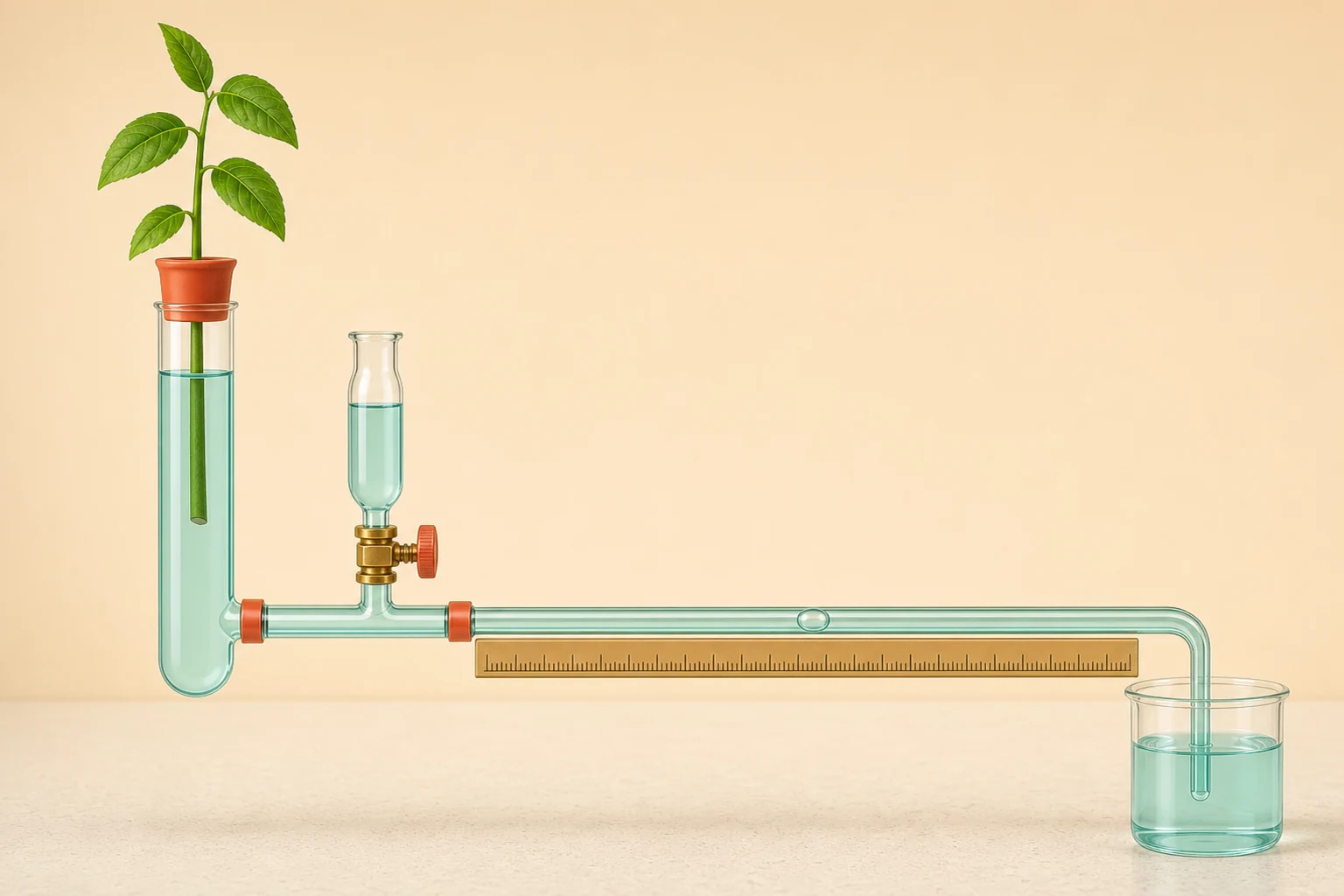
- Cut a leafy shoot under water to reduce air entering xylem.
- Assemble the water-filled apparatus under water and seal every joint.
- Introduce one air bubble into the capillary.
- Record the distance moved in a measured time.
- Use the reservoir to return the bubble to its starting point.
- Change one environmental variable, allow acclimatisation, repeat and calculate means.
A potometer measures water uptake, not transpiration directly. Some absorbed water is used in photosynthesis, growth or maintaining turgor, although most is often lost by transpiration under the test conditions.
Keep leaf area, shoot species, temperature and exposure time constant unless one is the independent variable. Check for leaks, repeat readings and calculate a mean.
Adaptations to dry environments
Xerophytes are plants adapted to conditions where water is scarce. Possible adaptations include:
- a thick waxy cuticle that reduces evaporation;
- fewer stomata or stomata sunk in pits that trap humid air;
- leaf hairs that reduce air movement near stomata;
- rolled leaves that enclose a humid space;
- small leaves or spines that reduce surface area;
- succulent tissues that store water;
- extensive shallow or deep root systems that improve water capture.
Name the feature, then state how it changes the diffusion gradient, exposed area or air movement.
Quick retrieval check
1. Where does water evaporate inside a leaf?
2. Why does moving air usually increase transpiration?
3. Why is a potometer an indirect measurement?
4. A bubble moves 36 mm in 12 minutes. Calculate the relative rate.
Exam connection
Explain why increasing temperature from 20°C to 30°C may increase potometer bubble speed, but increasing it further to 45°C may not.
Show the mark points
- Higher temperature initially increases evaporation and diffusion.
- This increases water loss and therefore water uptake.
- At very high temperature, water loss can exceed supply.
- Guard cells lose turgor or stomata close.
- The smaller stomatal opening reduces further water loss.