
What you need to know
- Explain how branching roots provide anchorage and a large absorbing area.
- Relate root hair cell structure to uptake.
- Explain water movement into roots by osmosis.
- Explain active transport of mineral ions.
- Describe nitrate and magnesium functions and investigate deficiency effects.
Root systems
Roots spread through soil, anchoring the plant and bringing absorbing surfaces into contact with water films around soil particles. Repeated branching increases the volume of soil explored. Some roots also store carbohydrates and other reserves.
Young regions behind the root tip contain many root hair cells. The growing tip itself is protected by a root cap, while a meristem produces new cells.
Root hair cell adaptations
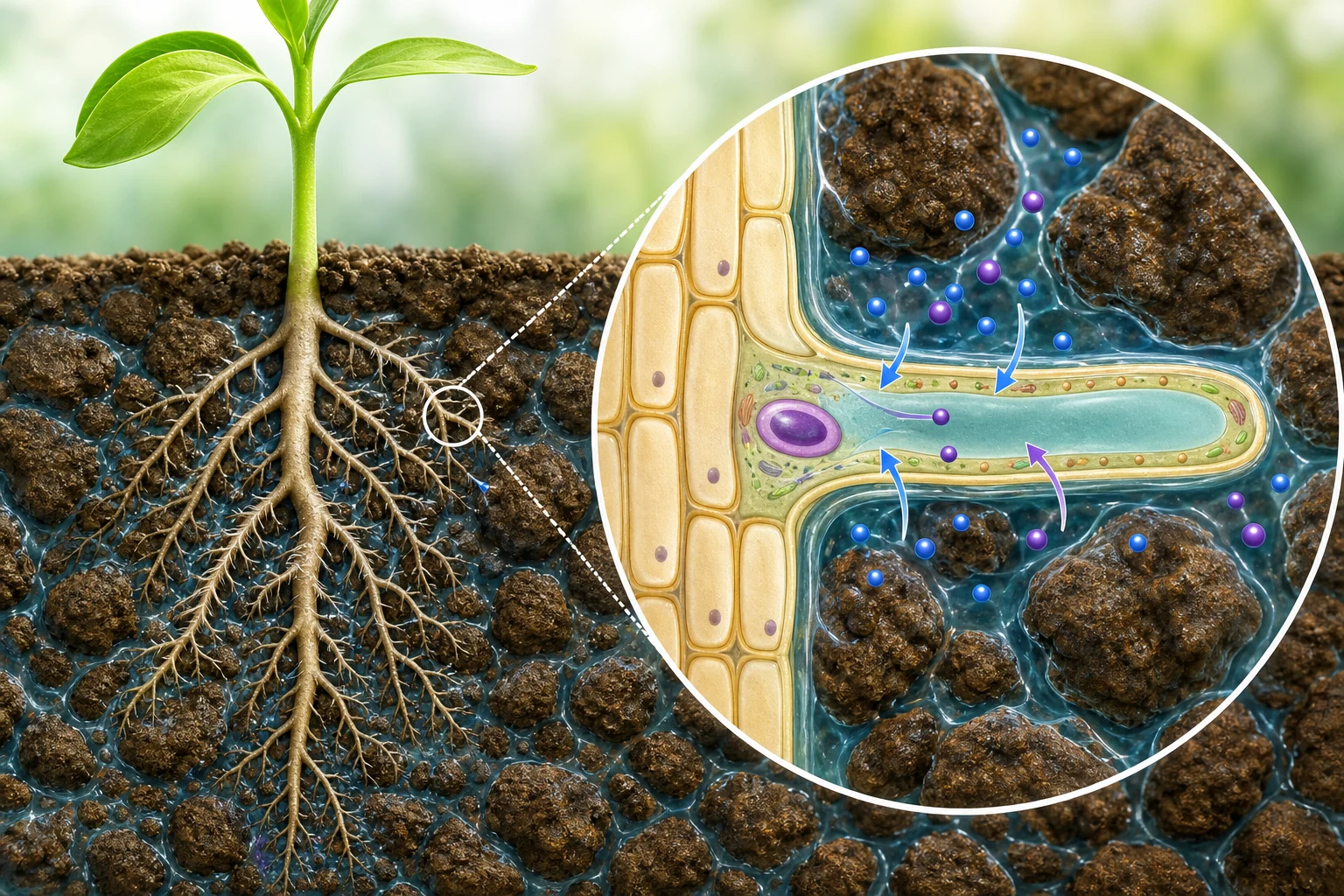
- A long hair-like extension provides a large membrane surface area.
- A thin cell wall gives a short path into the cell.
- A large vacuole containing cell sap helps maintain a water-potential gradient.
- Membrane transport proteins move particular mineral ions.
- Many mitochondria provide ATP for active transport where demand is high.
Misconception AlertA root hair is a tiny multicellular root.Select to reveal the correctionSelect to hide the correction
A root hair is a long extension of one epidermal cell that increases the surface area for absorption.
Water uptake by osmosis
Water moves from a region of higher water potential in the soil solution to lower water potential inside root hair cells through a partially permeable cell membrane. This net movement is osmosis.
Water then crosses the root cortex towards xylem. Evaporation from leaves and transport in xylem help maintain a water-potential gradient through the plant.
The net movement of water molecules through a partially permeable membrane from higher water potential to lower water potential.
If soil is extremely salty or dry, its water potential may be too low for effective uptake. Water may leave root cells, causing loss of turgor and reduced growth.
Mineral-ion uptake
Plants require mineral ions in small quantities, but ion concentration in the soil may be lower than inside root cells. Ions must then move against their concentration gradient by active transport. Carrier proteins in the cell membrane use energy transferred by respiration.
| Mineral ion | Use | Deficiency effect |
|---|---|---|
| Nitrate | Provides nitrogen for amino acids, proteins and nucleic acids. | Stunted growth and sometimes older leaves becoming yellow. |
| Magnesium | Required to make chlorophyll. | Chlorosis: leaves become yellow, reducing photosynthesis. |
Do not say mineral ions provide energy. They are raw materials. Glucose is used in respiration to release energy for active transport.
Investigating mineral deficiencies
- Grow matched seedlings in solutions containing all required mineral ions.
- Use comparison solutions each lacking one chosen mineral.
- Keep species, starting size, light, temperature, pH, solution volume and growth time constant.
- Aerate solutions if needed and support roots while keeping shoots above the liquid.
- Measure growth, dry mass or leaf colour using a consistent method.
- Use several plants per treatment and calculate means.
A complete nutrient solution is the positive control. A solution missing all minerals is not enough to identify which ion caused a particular effect.
Fresh mass is affected by water content. Dry mass better represents accumulated biological material, but destructive drying means different plants are required at the end.
Quick retrieval check
1. How does a root hair increase uptake?
2. Why can mineral uptake require active transport?
3. Why does magnesium deficiency cause yellow leaves?
4. Why should several plants be used per treatment?
Exam connection
A waterlogged soil contains little oxygen. Explain why mineral-ion uptake may decrease.
Show the mark points
- Root cells receive less oxygen.
- The rate of aerobic respiration decreases.
- Less ATP or usable energy is available.
- Active transport of ions against their concentration gradient slows.