
What you need to know
- Define positive and negative tropisms.
- Explain phototropism and gravitropism as survival responses.
- Use auxin distribution to explain unequal growth in shoots and roots.
- Describe roles of gibberellins and ethene.
- Explain commercial uses and design a seedling-response investigation.
Directional growth responses
| Response | Positive response | Negative response | Survival value |
|---|---|---|---|
| Phototropism | Growth towards light | Growth away from light | Shoots reach light for photosynthesis. |
| Gravitropism | Growth in the direction of gravity | Growth against gravity | Roots enter soil for anchorage and uptake; shoots grow upwards. |
Auxin and unequal growth
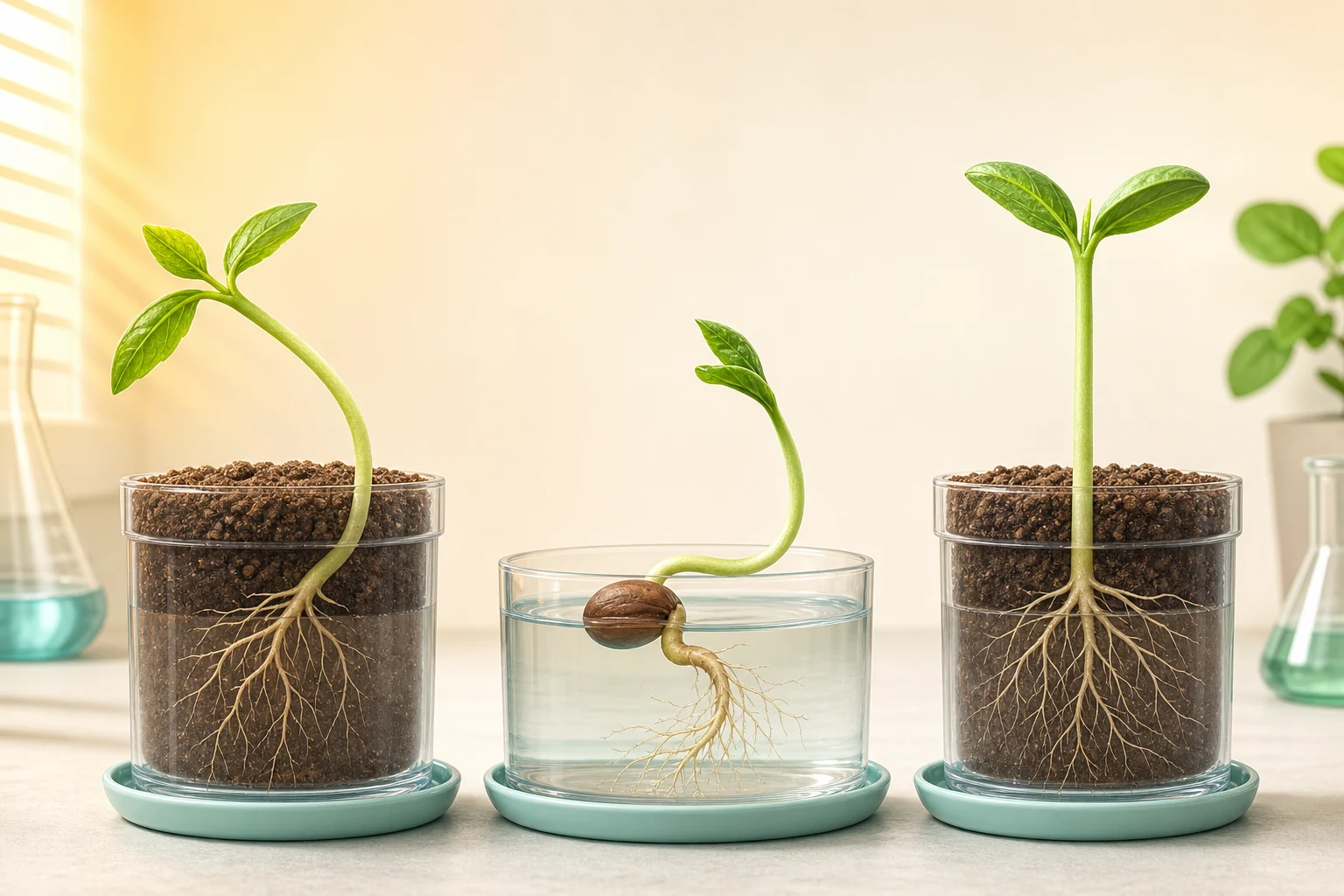
Auxin is produced mainly in growing shoot tips and moves through nearby tissues. Light from one side causes more auxin to act on the shaded side of a shoot. Auxin promotes cell elongation there, so the shaded side grows faster and the shoot bends towards light.
In a horizontal shoot, auxin accumulates on the lower side and promotes more elongation, bending the shoot upward. In a root, a high auxin concentration inhibits cell elongation. The upper side grows faster, so the root curves downward.
Shoot
More auxin usually promotes elongation; greater lower-side growth bends the shoot upward.
Root
High auxin inhibits elongation; greater upper-side growth bends the root downward.
Misconception AlertA stimulus physically pushes a plant towards or away from it.Select to reveal the correctionSelect to hide the correction
A tropic response occurs because cells on opposite sides grow by different amounts, causing the plant organ to bend.
Other plant hormones
| Hormone | Important roles |
|---|---|
| Gibberellins | Promote seed germination, stem growth and, in some plants, flowering and fruit growth. |
| Ethene | A gaseous hormone that promotes fruit ripening and contributes to ageing responses. |
Hormones act at low concentrations, and their effects depend on tissue, developmental stage, concentration and interactions with other signals.
Commercial uses of plant hormones
- Rooting powders: auxin-like chemicals encourage roots to form on cuttings.
- Selective weedkillers: high concentrations of synthetic auxins disrupt broad-leaved weed growth while grasses are less affected.
- Gibberellins: can end seed dormancy, control flowering, promote larger fruit or increase stem length.
- Ethene: controls and synchronises fruit ripening during storage and transport.
Applications should be evaluated for yield, consistency, cost, worker safety, environmental effects and unwanted responses in non-target plants.
Do not state that every plant hormone has one function. Effects vary with concentration and target tissue.
Investigating tropisms
- Use seedlings of the same species, age and starting size.
- Place one group in a lightproof box with a side opening and another under even overhead light.
- Keep temperature, water, growth medium and time constant.
- Photograph seedlings from a fixed position at regular intervals.
- Measure curvature angle or change in tip position.
- Repeat with several seedlings and calculate means.
For gravitropism, place germinating seeds horizontally and use a slowly rotating clinostat as a comparison where available. A clinostat continually changes the direction of gravity relative to the seedling, reducing a consistent directional stimulus.
Seedlings naturally vary. Randomly assign them to groups, use several per treatment, define how curvature will be measured and prevent unintended light entering the apparatus.
Quick retrieval check
1. What is positive phototropism?
2. Why does a shoot bend towards one-sided light?
3. How does auxin affect a horizontal root?
4. Name one commercial use of ethene.
Exam connection
A student removes the tips from one group of shoots. These shoots do not bend towards side light. Explain the result.
Show the mark points
- The shoot tip is the main site of auxin production or light detection.
- Removing it prevents the normal unequal auxin effect.
- Cells on the shaded side do not elongate more than those on the lit side.
- No unequal growth means no curvature towards light.