
What you need to know
- Identify the main structures in animal and plant cells.
- State the function of each structure.
- Explain the similarities and differences between animal and plant cells.
- Relate the number of particular organelles to the function of a cell.
Structures shared by animal and plant cells
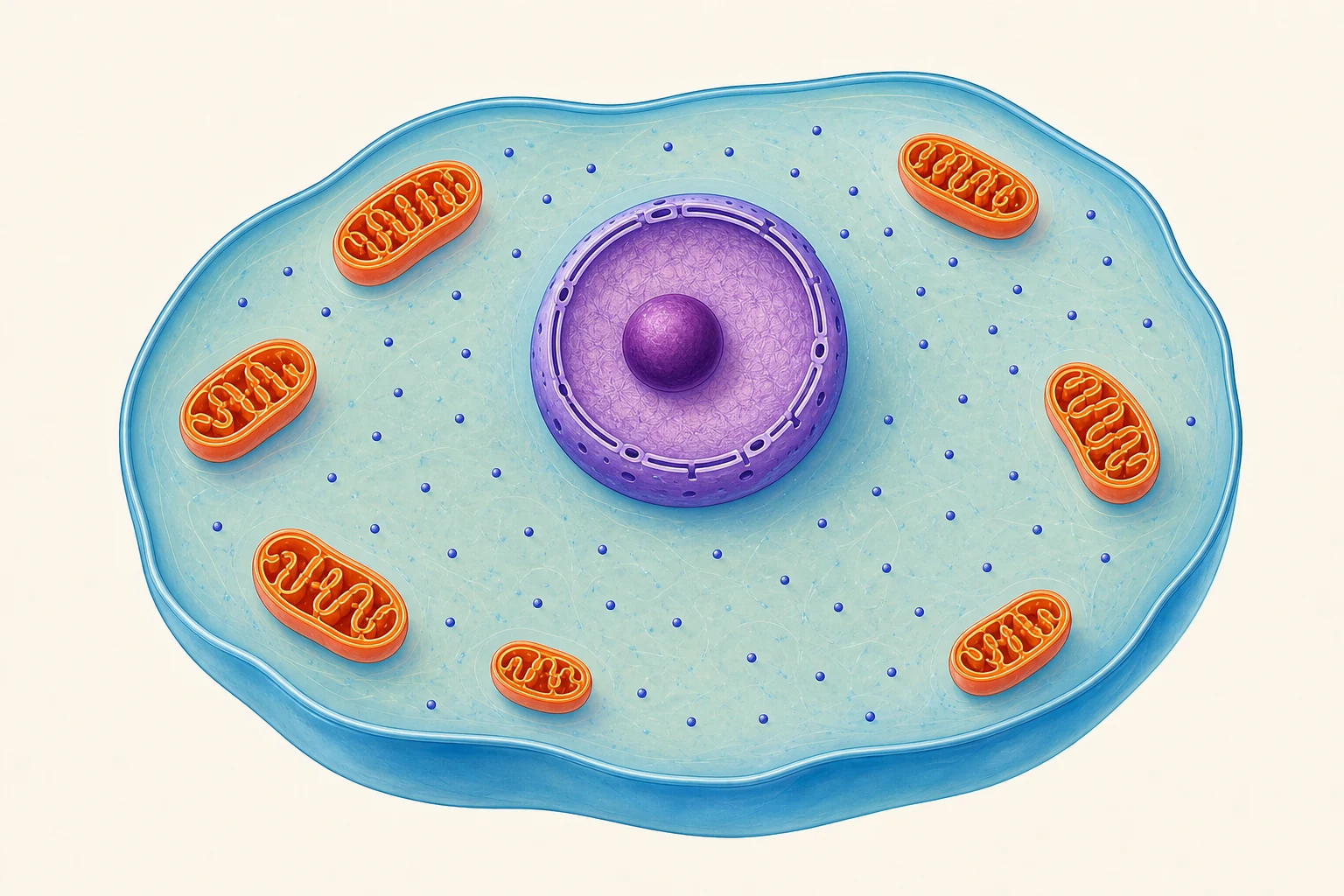
Both animal and plant cells are eukaryotic, so they contain a nucleus and other specialised internal structures. In GCSE questions, you should recognise a structure from a diagram and explain its function precisely.
| Structure | Function | Useful detail |
|---|---|---|
| Nucleus | Contains genetic material and controls the cell's activities. | DNA is arranged into chromosomes. |
| Cytoplasm | Where most chemical reactions in the cell take place. | Contains enzymes that control reactions. |
| Cell membrane | Controls movement of substances into and out of the cell. | It is selectively permeable. |
| Mitochondria | Where most aerobic respiration takes place. | Cells with high energy demands contain many mitochondria. |
| Ribosomes | Where proteins are made. | Ribosomes are not surrounded by membranes. |
Misconception AlertRespiration means breathing.Select to reveal the correctionSelect to hide the correction
Respiration is a series of chemical reactions in cells that release energy. Most aerobic respiration reactions occur in mitochondria; breathing is the movement of air into and out of the lungs.
Additional structures in plant cells
Typical photosynthetic plant cells contain all five shared structures plus a cellulose cell wall, chloroplasts and a permanent vacuole.
| Structure | Function | Key distinction |
|---|---|---|
| Cellulose cell wall | Strengthens and supports the cell and helps it keep its shape. | It is outside the cell membrane and is freely permeable. |
| Chloroplast | Site of photosynthesis; contains chlorophyll that absorbs light. | Not every plant cell has chloroplasts. Root cells underground usually do not. |
| Permanent vacuole | Contains cell sap and helps support the cell when filled with water. | Cell sap is a solution of water and dissolved substances. |
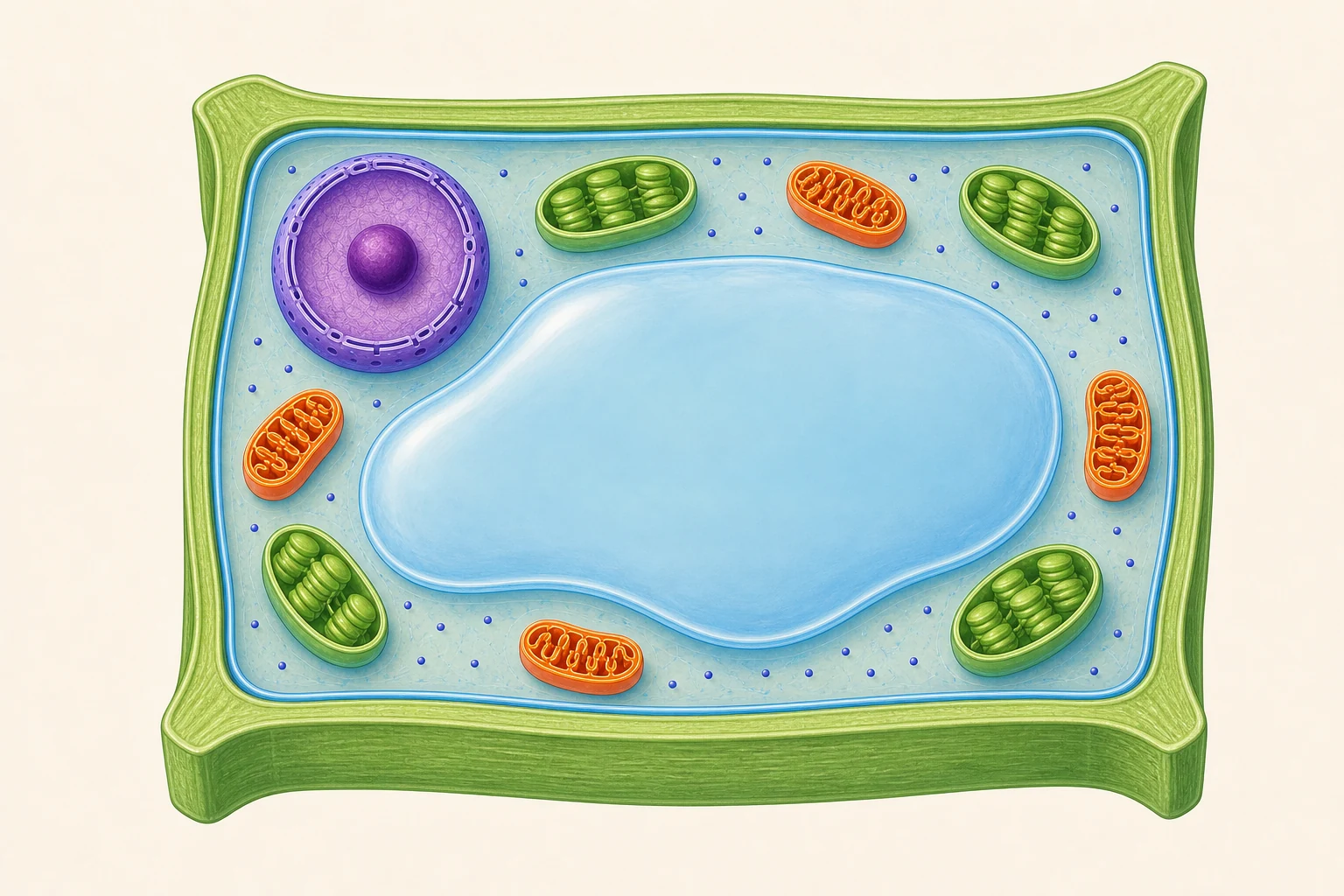
Do not state that “plants have a cell wall instead of a cell membrane”. Plant cells have both. The membrane controls movement; the wall provides strength and support.
Comparing animal and plant cells
Animal cell
- Nucleus, cytoplasm and cell membrane
- Mitochondria and ribosomes
- No cellulose cell wall
- No permanent vacuole
- No chloroplasts
Plant cell
- All the structures found in a typical animal cell
- Cellulose cell wall
- Large permanent vacuole
- Chloroplasts in photosynthetic cells
- Often has a more regular outline
The word organelle means a specialised structure inside a cell. At GCSE, the term is commonly used for the nucleus, mitochondria, ribosomes and chloroplasts.
Organelle abundance and cell function
Cells do not all contain the same number of each organelle. The number reflects what the cell does.
- A muscle cell needs a large energy transfer and therefore contains many mitochondria.
- A cell making and secreting many proteins contains many ribosomes.
- A palisade mesophyll cell absorbs light and contains many chloroplasts.
- A root hair cell underground does not photosynthesise and normally has no chloroplasts.
A strong biological explanation identifies a structural feature, states its effect, and connects that effect to the cell's function.
Example: a palisade cell contains many chloroplasts, so it absorbs more light energy and can carry out photosynthesis at a high rate.
Quick retrieval check
1. Name five structures found in both animal and plant cells.
2. What is the difference between a cell wall and a cell membrane?
3. Why do active muscle cells contain many mitochondria?
4. Why do most root cells lack chloroplasts?
Exam connection
A cell has a nucleus, a cell membrane, mitochondria, ribosomes, a cell wall and a large permanent vacuole, but no chloroplasts. Explain why it can still be a plant cell.
Show the mark points
- The cellulose cell wall and permanent vacuole are characteristic plant-cell structures.
- Not all plant cells photosynthesise.
- A cell that receives no light, such as a root cell, does not need chloroplasts.
Command word: Explain requires linked scientific reasons, not just a list of structures.